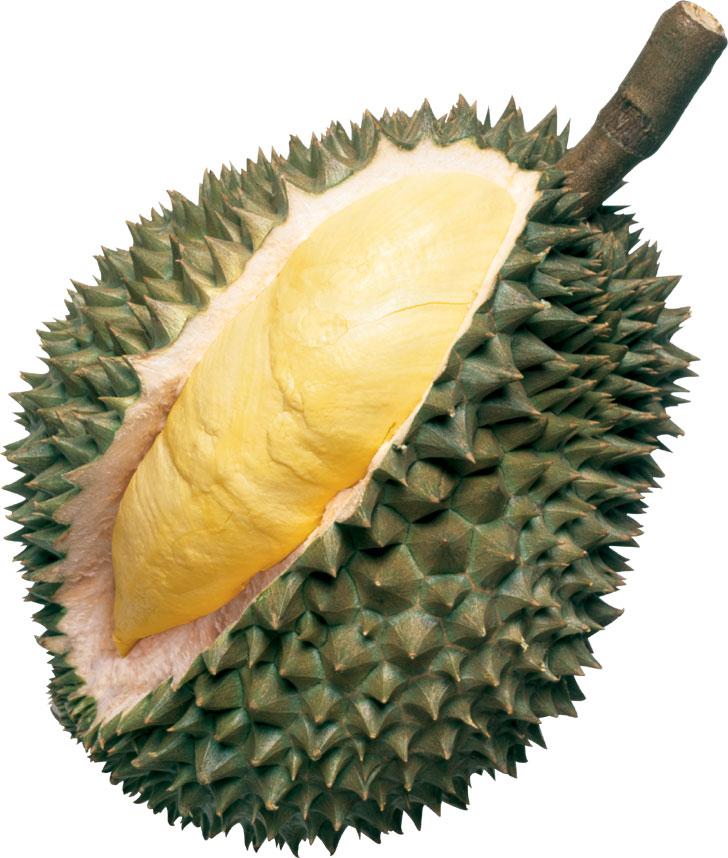
kidlogic wrote:Whoa! That thing means bizness!

Is it as tasty as it is evil looking?
It smells like death. Quite literally. However it tastes creamy and sweet with a slight hint of cheese.

Flavour and odour
The unusual flavour and odour of the fruit have prompted many people to formulate evocative descriptions, with widely divergent and passionate views expressed, including deep appreciation and intense disgust.
Writing in 1856, the British naturalist Alfred Russel Wallace provides a much-quoted description of the flavour of the durian:
“ The five cells are silky-white within, and are filled with a mass of firm, cream-coloured pulp, containing about three seeds each. This pulp is the edible part, and its consistence and flavour are indescribable. A rich custard highly flavoured with almonds gives the best general idea of it, but there are occasional wafts of flavour that call to mind cream-cheese, onion-sauce, sherry-wine, and other incongruous dishes. Then there is a rich glutinous smoothness in the pulp which nothing else possesses, but which adds to its delicacy. It is neither acid nor sweet nor juicy; yet it wants neither of these qualities, for it is in itself perfect. It produces no nausea or other bad effect, and the more you eat of it the less you feel inclined to stop. In fact, to eat Durians is a new sensation worth a voyage to the East to experience. ... as producing a food of the most exquisite flavour it is unsurpassed.[15] ”
While Wallace cautions that "the smell of the ripe fruit is certainly at first disagreeable", more recent descriptions by westerners can be more graphic. British novelist Anthony Burgess writes that eating durian is "like eating sweet raspberry blancmange in the lavatory."[16] Travel and food writer Richard Sterling says:
“ ... its odor is best described as pig-shit, turpentine and onions, garnished with a gym sock. It can be smelled from yards away. Despite its great local popularity, the raw fruit is forbidden from some establishments such as hotels, subways and airports, including public transportation in Southeast Asia.[17] ”
Hydrogen sulfide, one of the chemical compounds that may be responsible for the characteristic odour of durian
Hydrogen sulfide, one of the chemical compounds that may be responsible for the characteristic odour of durian
Other comparisons have been made with the civet, sewage, stale vomit, skunk spray and used surgical swabs.[18] The wide range of descriptions for the odour of durian may have a great deal to do with the wide variability of durian odour itself. Durians from different species or clones can have significantly different aromas; for example, red durian (D. dulcis) has a deep caramel flavour with a turpentine odour, while red-fleshed durian (D. graveolens) emits a fragrance of roasted almonds.[19] Among the varieties of D. zibethinus, Thai varieties are sweeter in flavour and less odourous than Malay ones.[2] The degree of ripeness has a great effect on the flavour as well.[2] Three scientific analyses of the composition of durian aroma — from 1972, 1980, and 1995 — each found a different mix of volatile compounds, including esters, ketones and many different sulfur compounds, with no agreement on which may be primarily responsible for the distinctive odour.[2]
This strong odour can be detected half a mile away by animals, thus luring them. In addition, the fruit is extremely appetising to a variety of animals, from squirrels to mouse deer, pigs, orangutan, elephants, and even carnivorous tigers. While some of these animals eat the fruit and dispose of the seed under the parent plant, others swallow the seed with the fruit and then transport it some distance before excreting, with the seed being dispersed as the result.[20] The thorny armoured covering of the fruit may have evolved because it discourages smaller animals, as larger animals are more likely to transport the seeds far from the parent tree
http://en.wikipedia.org/wiki/Durian